Nest Failures Raise Alarm Along the Atlantic Coast
The Osprey is one of North America’s greatest conservation success stories, but something has gone wrong recently along the Atlantic Seaboard. Some of the region’s largest Osprey populations have experienced widespread reproductive failure, starving chicks, and abandoned nests. Researchers are working to understand why, but the crisis appears to be tied to a stark decline of Atlantic menhaden, a fish that Ospreys in the region depend on for food. It is not definitively known why menhaden have become scarcer, although overfishing is possibly a factor.
Dr. Bryan Watts of the Center for Conservation Biology at the College of William & Mary and his colleagues have been documenting Osprey populations in the Chesapeake Bay since 1970. Dr. Watts reports that, in 2026, Ospreys“have never had a year when productivity was this low.” Reproductive rates in parts of Chesapeake Bay have been “underwater since the mid-2000s,” but this is the worst year so far, with productivity having declined over the past five years or so.
In Dr. Watts’s observation, all evidence seems to indicate that the cause of the collapse is food stress. Low egg-laying percentages, nest abandonment, brood asymmetry, brood reduction, small brood size, and nest failure all suggest food stress is the reason for poor reproductive success. According to Dr. Watts:
Menhaden delivery to nests has dropped 80% since the 1980s, while productivity has gone down and brood reduction has gone up. Menhaden has dropped from just below 70% of the diet to below 30%. The shift away from menhaden has caused a 50% reduction in overall diet quality. Low provisioning rates on top of poor diet quality are not sustainable.
Dr. Watts stresses that Ospreys are an ecological indicator for the ecosystems they are part of. Ospreys are more readily observable because they occupy a higher trophic level, but there are no doubt other species struggling in less visible ways.

Osprey-1
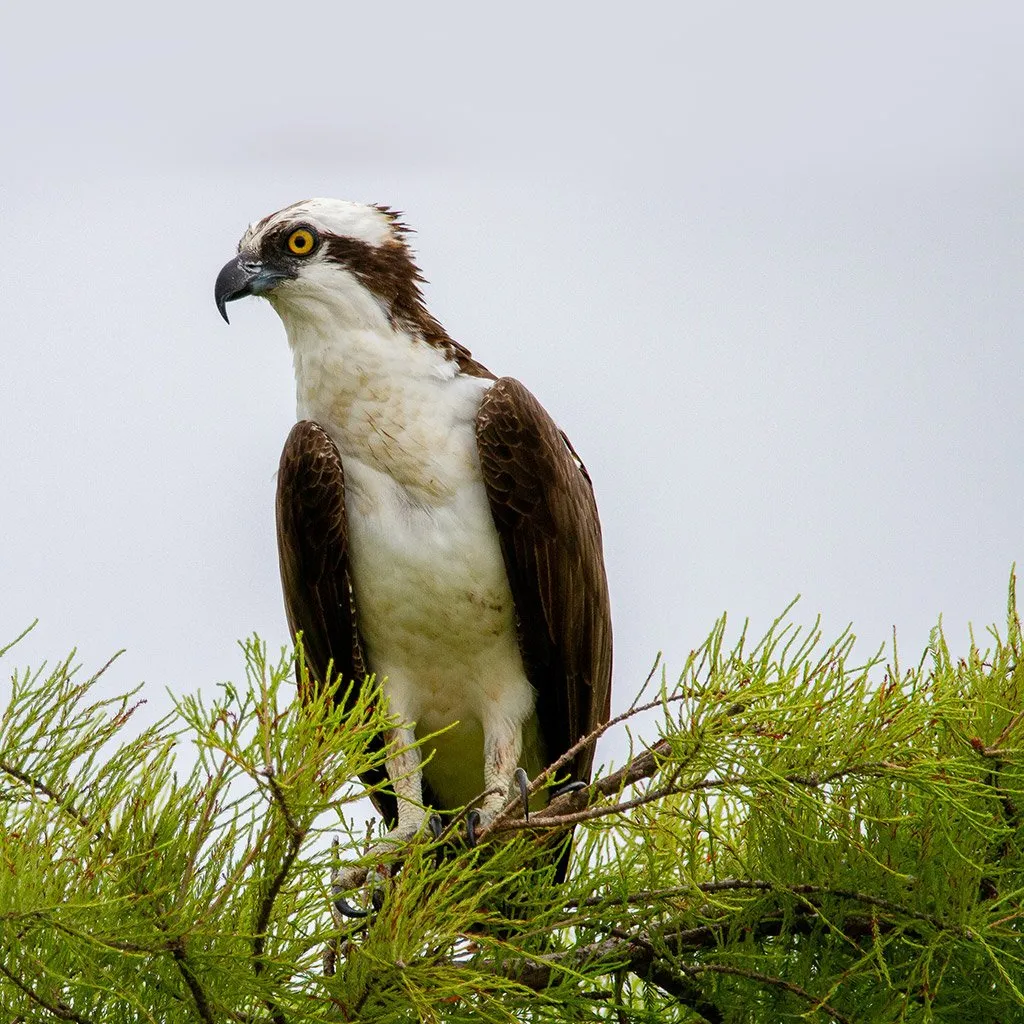
Researchers have lately documented exceptionally poor Osprey nesting success across stretches of the Atlantic Seaboard. Photo by © George Armistead.

Osprey-2
This Osprey is likely carrying nesting material, but many nests along the Atlantic Coast have failed this year. Photo by © George Armistead.

Osprey-3
After recovering from the brink in one of the ABA Area’s greatest conservation success stories, Ospreys along the Atlantic Coast are now struggling as Atlantic menhaden become less available. Photo by © George Armistead.

Osprey-4
The Osprey is one of the world's most familiar birds of prey and has inspired countless people to become interested in birds and conservation. Photo by © Joshua J. Cotten.
The crisis does not seem to be limited to the Chesapeake Bay. Reproductive success was also poor last year in New Jersey, and this year there have been reports of poor reproductive success all the way up the Atlantic Coast to Nova Scotia.
The scope of the crisis remains unknown. When the field season ends, Dr. Watts and his colleagues will be compiling data from all along the coast. Inland and other populations of Osprey do not seem to be affected, surely because they feed on other fish species.
The spectacle of starving Osprey chicks is not for the faint of heart. Ben Wurst, Senior Wildlife Biologist for the Conserve Wildlife Foundation of New Jersey, monitors nests on Barnegat Bay, in Ocean County, which has around 150 nesting pairs of Ospreys. He reports:
At nests that I’ve watched very closely this summer, signs of food stress have been evident by: the lack of males at nests, as they spend more time/energy foraging; young being left at nests unattended, while both adults attempt to forage; males returning to their nests that contain young with very small prey (menhaden) and eating the entire fish while their mates and young beg for food; adults becoming more separated from their nests with young and leaving at sunset to perch in nearby forested habitat, as they can tell their young are dying (where I have witnessed this the young all died of starvation); the silence of Ospreys in colonies where only a few Osprey nests still have young.
The Atlantic menhaden is a small schooling fish found along the Atlantic Coast from Nova Scotia to Florida. Menhaden feed on plankton and become food for countless predators. In addition to Ospreys, Bald Eagles, other fish, whales, and dolphins feed on the species. So when menhaden populations crash, there is a ripple effect throughout the coastal food web.
The Osprey is among the world’s most widespread birds of prey, occurring on every continent except Antarctica. In most taxonomies, four subspecies are recognized globally. Pandion haliaetus carolinensis is the migratory subspecies that breeds across much of the U.S. and Canada, with many individuals migrating thousands of miles each fall for the nonbreeding season in the Caribbean, Central America, and South America before returning each spring.
The Osprey is one of the bird world’s great ambassadors: How many people have become interested in birds and birding after watching an Osprey dramatically plunge into the water and then strain with massive wingbeats to lift itself back into the air with a fish writhing in its talons?
Birders can play an important role now by reporting Osprey nesting activity through local monitoring programs and community science projects, which helps researchers track the scope of the problem. Ben Wurst stresses that birders are an asset to monitoring ospreys worldwide, especially as we transition into late summer. The website osprey-watch.org has a map feature and birders can check for nests near their home, and if a nest does not have next activity, then it is in need of a watcher. Unmapped nests can also easily be mapped. There are monitoring groups all along the coast who help organize volunteers to gain valuable data: Anyone can join these groups and contribute. Birders can also advocate for sustainable management of Atlantic menhaden and support habitat conservation organizations working to protect healthy coastal ecosystems.
The ABA thanks Scott Weidensaul, Dr. Bryan Watts, Ben Wurst, and David Gessner for helping with the creation of this story and for their advocacy for Ospreys. Check out Gessner’s recent article on Ospreys in Audubon magazine.

Frank Izaguirre is Marketing & Communications Manager for the ABA. Frank runs the ABA’s social media, writes articles for the ABA’s website, and coordinates the ABA’s marketing strategies. Frank is also in charge of the Bird of the Year Program, collaborating with the Bird of the Year artist and writing articles that promote the Bird of the Year Program and conservation efforts related to the Bird of the Year. Frank appears regularly on the American Birding Podcast as a guest and occasionally as a guest host; he has written for Birding, and he has served as a mentor in the ABA’s Young Birder Programs. Frank enjoys local birding in bad weather and networking with birders around the world. He also loves looking for salamanders and moths. Frank and his wife Adrienne and daughter Maya live in Pittsburgh, Pennsylvania, where Frank’s birding patch is urban Schenley Park.


