The Feather Wars: And the Great Crusade to Save America’s Birds, by James H. McCommons
St. Martin’s Press, 2026
416 pages, hardcover
ABA Sales–Buteo Books 15630

One of my favorite birding haunts, not far from my house, is an extensive city park along the Arkansas River. With a mix of woodlands, open fields, marshes, and water, it is easy to tally a good list of species in short order. One bird that is guaranteed to be on that list is the Canada Goose. In the summer, I’m just as likely to see Great Egrets and, often, a Snowy Egret or two. That these species, and many more with them, are expected, even unremarkable, is thanks to the people profiled in the new book by James McCommons, The Feather Wars.
Exhaustive, but never exhausting, The Feather Wars tells the double story of the plunder of American birds and the conservation movement that sought to stop it. As we know, such efforts were incomplete—it was too late for the Passenger Pigeon and Great Auk—but, as McCommons writes, “Canada Geese, despite their reputation as a national pest, are a great conservation story, as is the Wild Turkey, Wood Duck, Trumpeter Swan, and Bald Eagle, all brought back from the brink of extinction by human intervention.”
This intervention was accomplished by odd alliances and a cast of characters, beginning in the post-Civil War “Gilded Age” and continuing to the present. From scientists to sportsmen to “sentimentalists”—it took many types to turn the tide for birds. McCommons tells the stories of many of them, from organizations to individuals. Among those stories are people who will be familiar figures to many birders, such as Frank M. Chapman, Editor of Bird-Lore and founder of the Christmas Bird Count. Also familiar is Florence Merriam Bailey, who helped organize a movement against feather adorned hats as a college student and went on to write the first field guide to birding with optics. It was Bailey, in 1896, who was the first to use the term “birding” in print.
There are few perfect heroes in The Feather Wars. The figures who did so much good for birds, in the end, also did damage through their limited knowledge and the prejudices of their age toward both birds and people. Mabel Osgood Wright, another pioneering figure in the bird conservation movement, set up her own preserve. She patrolled it with a .22 rifle, killing any cats she found, but also Cooper’s and Sharp-shinned hawks—“the two bad hawks,” in Wright’s mind—which were summarily executed. In the age of shotgun ornithology, many in the scientific camp also contributed to the losses, killing some of the last individuals of a species for the sake of a museum collection.
Alongside the ornithologists were bird “sentimentalists,” among them John Burroughs, a friend of Walt Whitman who wrote of birds as a poet more than as a scientist. As McCommons writes, Burroughs “had an antipathy for scientists, who seemed to know little about the life and behavior of birds and who spent their time indoors working with specimens.” Burroughs went so far as to say that the “closet naturalist…is not only the enemy of the birds, but enemy of all who would know them rightly.” As one would guess, many ornithologists had an equal disdain for the Romantic sentimentalists. However, it was the combination of the two, poetic scientists and scientific poets, who made the best conservationists in the end. There was a need to understand what was happening to the birds, but also a need to draw public sympathy for their plight. Together, the scientists and sentimentalists were able to accomplish these necessary tasks, along with the help of “sportsmen” hunters. But for all of them to be effective, they also needed organizations through which they could advocate for conservation.
McCommons explores the many organizations, magazines, and institutions, local and national, that led the way in bird conservation. George Bird Grinnell, a hunter and naturalist who edited the influential sportsman magazine, Forest and Stream, helped found the first Audubon Society and published the first Audubon Magazine. Along with his friend Theodore Roosevelt, he also founded The Boone and Crocket Club, an organization of wealthy hunters who sought to adopt an ethics of hunting that is still influential today.
Having been a part of Audubon groups local, state, and national for over 30 years, I never knew that there were actually two waves of the Audubon movement, nor did I know that the Audubon Societies, along with the American Ornithologists’ Union (AOU, today the American Ornithological Society), employed their own private mercenary force of game wardens to fight poachers and plume hunters in their early years. The work of saving America’s birds was not all about magazines and societies, nature preserves, and federal regulation. From Pinkerton detectives to sharp-shooter game wardens, the work of protecting birds required martial skills as well as ornithological ones.
While the “war” in the title of McCommons’s book is sometimes a metaphor, it is just as often a real description of the outright violent conflict between conservationists and plume, market, and pot hunters. From gangs of duck hunters on the Chesapeake Bay to the mafia style organization, The Black Hand, McCommons introduces us to the figures on both sides of the conflict. For all of us who have had the pleasure of watching spoonbills in Florida, it is good to know the story of people like Guy Bradley, an AOU/Audubon warden murdered by plume hunters in 1905.
Protecting birds, of course, also included the more mundane work of passing laws. From Theodore Roosevelt’s executive orders establishing the first federal bird preserves to the Weeks–McLean Act of 1913, which provided the first protections for nongame species, McCommons offers the legal side of the story with just as much of an eye for drama as the chapters on armed conflict.
We are, all of us, a part of history. Reading The Feather Wars renewed a sense of that history for me. From picking up a pair of binoculars and a field guide, to going to my local national wildlife refuge, I am reminded that what I take for granted came because of the work, passion, and sacrifice of many before me. But the history offered in The Feather Wars also opens a place for our own contributions for the next part of the story.
As I was finishing the book, my local birding community was exchanging emails and outrage at a data center planned for a nearby bayou. It is a popular birding hotspot and an important migratory stopover. With the story of The Feather Wars fresh in mind, my own actions in the face of such a project are being guided by the winning mix that came before us—good science, a poetic appeal to the public, and governmental allies in the cause. As The Feather Wars makes clear, there have always been wins as well as losses. The important thing is continuing to fight for the sake of those feathered creatures who stir our hearts to action.
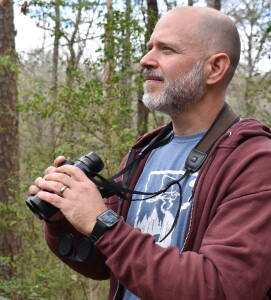
Ragan Sutterfield has been birding his native Arkansas for over 30 years. His most recent book is Watch and Wonder: Birding as a Spiritual Practice (Broadleaf, 2026).