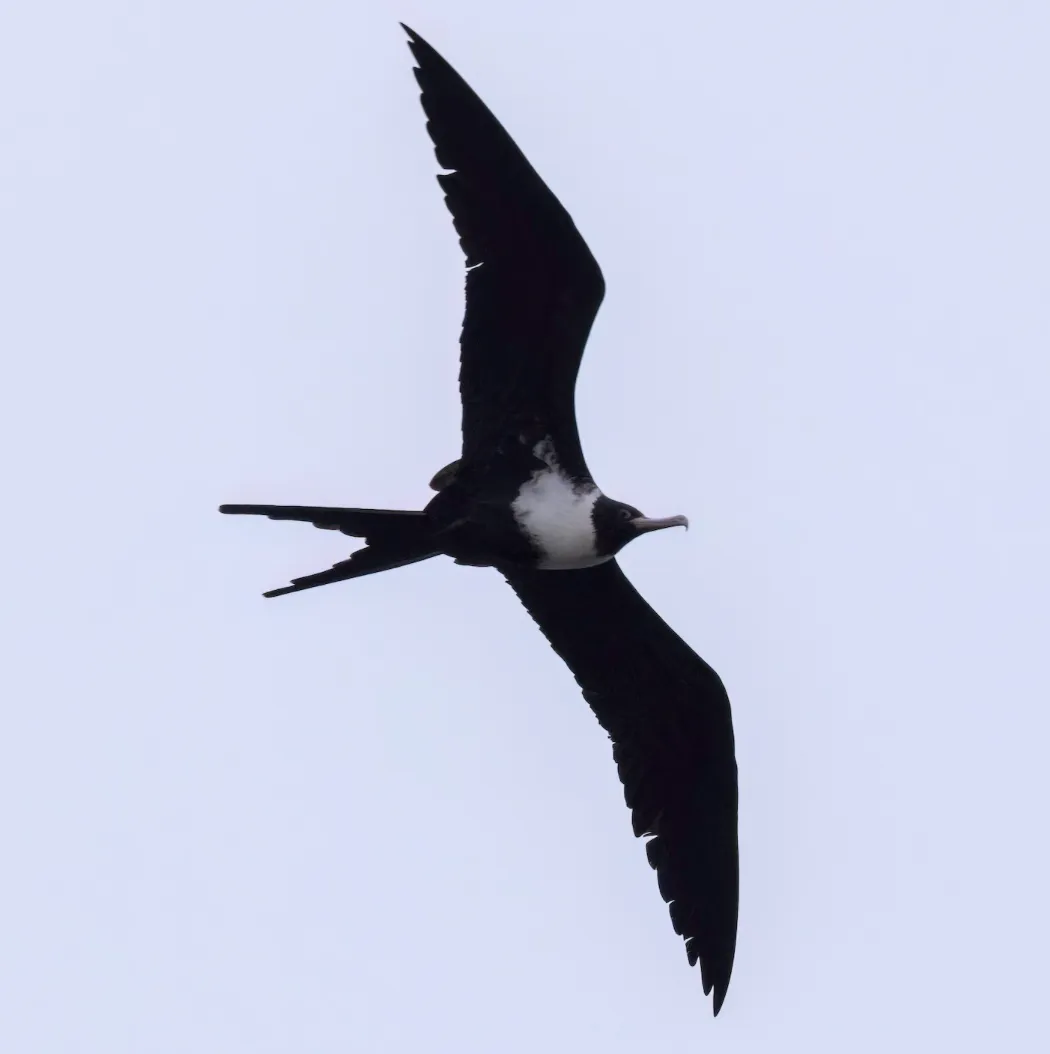
Continuing rarities in the ABA Area include Kelp Gull (ABA Code 4) in Wisconsin, and long-staying Mottled Owl (5) and Brown Jay (4) in Texas.
What a strange and birdy period we had in late May! When we look back on the oddest vagrants of 2026, it will be hard to top a Lesser Frigatebird (5) in Stark Co, Ohio! This surprising record is about the 7th or so for the ABA mainland (there are a handful of records from the northwest Hawaiian Islands) and, unsurprisingly, a 1st record for that state. Interestingly, it is not a regional first however. A 2005 record from south of Detroit, Michigan, remains as further indication of this South Pacific seabird’s propensity to wander.
And to add to the surprise, this wasn’t even the only Lesser Frigatebird in the ABA Area last month, as a Lesser Frigatebird (5) in Orange Co, seen at roughly the same period and originally misidentified as the more expected Magnificent Frigatebird, represent’s that state’s 2nd record. The first was seen only last year nearby in San Diego County. One wonders if this summer’s especially strong El Niño phenomenon is behind these two records, and whether we might see more in the coming months. More on Lesser Frigatebirds in the ABA Area on the ABA website.
This was also a notable period for seabirds on the other side of the continent, as a European Storm-Petrel (3) seen from shore in Cape May Co, New Jersey, represents a 1st for that state. Most ABA Area records of this species come from the Gulf Stream waters off of North Carolina where, as luck would have it, a European Storm-Petrel was sighted just the day before the New Jersey record.
This is also a productive season for overshooting Fork-tailed Flycatchers (3) in the ABA Area, as northbound post-breeders of this famous austral migrant can show up just aboutanywhere on the continent. A Fork-tailed Flycatcher in Santa Fe Co, New Mexico, is that state’s long-awaited 1st.
And that wasn’t all, a Fork-tailed Flycatcher (3) in the District of Columbia is that region’s 1st record as well, as especially appropriate as this spring as already seen records from both Maryland and Virginia.
Florida is no stranger to bonkers records, but perhaps no one predicted a Red-faced Warbler, one of the classic breeding birds of southwestern mountains, in Levy Co. This is a Florida 1st, but records in Georgia (2010) and Louisiana (1990) suggest the possibility, however unlikely, that this species can wander a bit.
The run of interesting terns in the midwest continues into late May with a Illinois 1st Roseate Tern in Lake Co. Last year saw both Ohio and Pennsylvania record this species on Lake Erie – the same individual for both sightings. That bird was banded and this one is not, confirming that this is, indeed, a different bird and a second for the Great Lakes.
Oregon’s best known eastern rarity magnet, the green oasis around the Malheur NWR headquarters in Harney Co, produced another extraordinary bird this week in Oregon’s 1st Connecticut Warbler. Also notable for the state, a Least Tern, the latest of fewer than 20 records, in Clatsop Co.
North to Alaska, where birders on the western outposts are starting to turn up some exciting East Asian vagrants. Highlights include Falcated Duck (4), Green Sandpiper (3), and multiple Terek Sandpipers (3) on St Paul Island. Eurasian Hobby (4) and Fieldfare (3) on Adak, Eyebrowed Thrush (3) on Shemya, and Siberian Rubythroat (4) on Buldir. On the mainland, a Taiga Flycatcher (4) at Utqiakvik is a fantastic find.
Noteworthy birds in British Columbia include the province’s 4th Wood Sandpiper at Port Hardy, and a Northern Parula at Cranbrook.
Next door in Alberta, a Bar-tailed Godwit (3) in Strathcona Co is a provincial 2nd, and a Orchard Oriole in Medicine Hat the 6th.
Birders in Nevada have produced a fine array of eastern vagrants at the traditional migrant traps, with highlights of Kentucky Warbler in Beatty, Bay-breasted Warbler at Fallon, Baltimore Oriole in Tonopah, and a stunning Yellow-throated Vireo at Corn Creek.
To Arizona, where a Black-vented Oriole (4) in Cochise Co is that state’s 2nd record.
Crossing the continent to Delaware, where the state’s 7th Wood Stork was seen at Port Penn.
St Pierre et Miquelon becomes the latest spot to partake in the Ruff (3) bonanza this spring.
And in Prince Edward Island, a Crested Caracara at East Point is the province’s 2nd record.
Omissions and errors are not intended, but if you find any, please message blog AT aba.org and we will try to fix them as soon as possible. This post is meant to be an account of the most recently reported birds. Continuing birds not mentioned are likely included in previous installments of the ABA Rare Bird Alert. Readers should note that most of these reports have not yet been vetted by a records committee. All birders are urged to submit documentation of rare sightings to the appropriate state or provincial records committees. For full analysis of these and other bird observations, subscribe to North American Birds, the richly illustrated journal of ornithological record published by the ABA.


