A Leap Forward in Understanding Bird Vagrancy
September 29, 2024
A review by David Irons
Vagrancy in Birds by Alexander Lees and James Gilroy
Princeton University Press, 2022
400 pages, hardcover
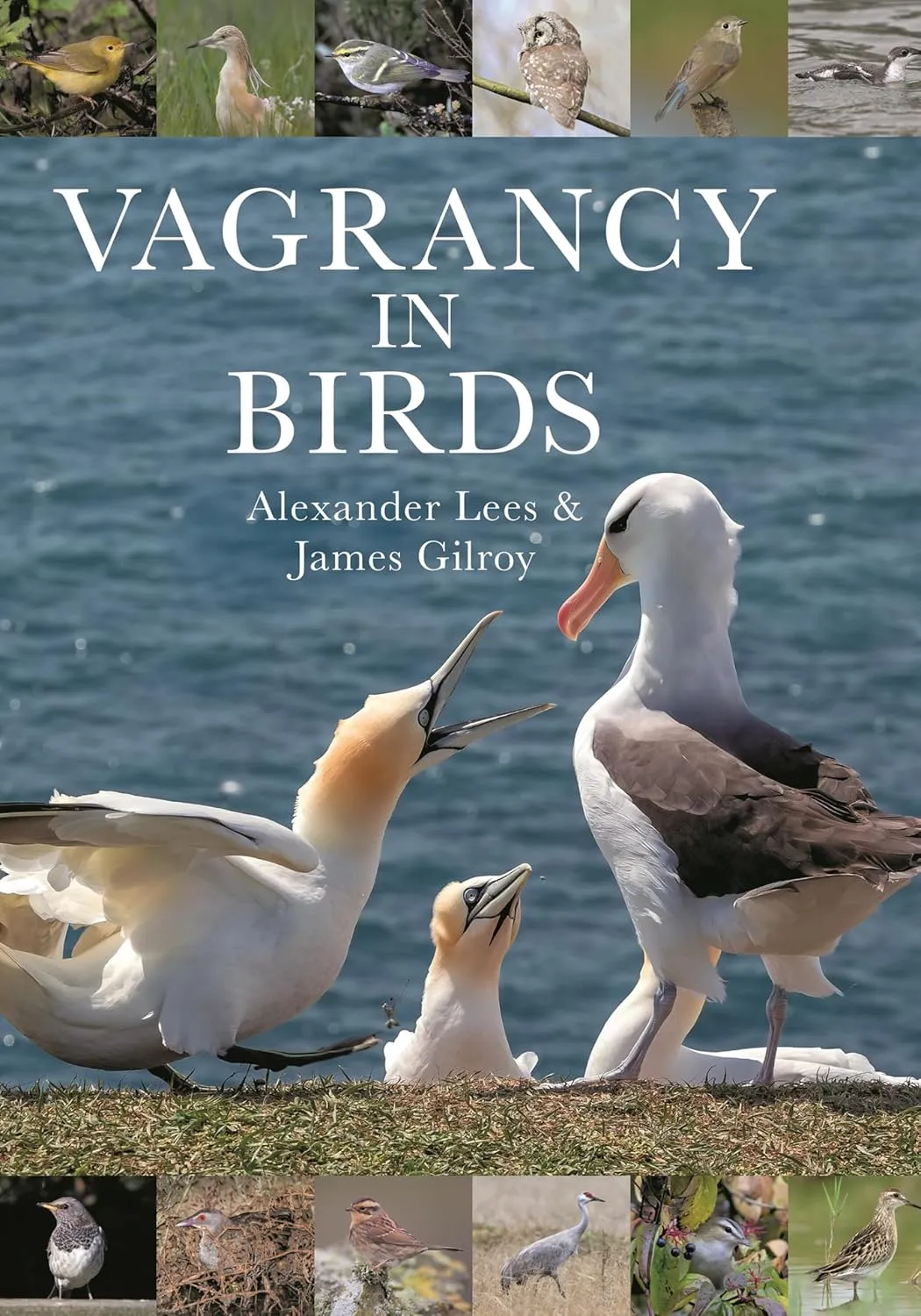
At first glance, one might expect a 400-page book on the topic of bird vagrancy to be a daunting slog through dense scientific data and highly complex technical explanations of how birds navigate, but don’t let that deter you. Vagrancy in Birds by Alexander Lees and James Gilroy is both well-researched and well-written, and thus accessible to anyone who is fascinated by avian migration and vagrancy. This book offers yet another step forward along our path to better understanding how birds find their way, and more importantly why they often end up in unexpected places.
This volume features three major components. Although the authors suggest that the family accounts are the “major part of the book” (264 pages), the real meat and potatoes can be found in the opening 70 pages. Here, Lees and Gilroy start by offering a broader and more detailed definition of the term “vagrant,” acknowledging that building a fence around this concept has proven challenging. They include vagrants that travel only short distances and even those whose movements may have been aided or abetted by human activities. Traditionally, the term vagrant was reserved for birds that wandered far off course. It was generally believed that such birds were either wandering somewhat randomly due to a flawed internal navigation system, or that they had been “blown off course” by weather events while otherwise on an expected heading. In the past, some biologists treated vagrants as inconsequential outliers, essentially irrelevant in the outcome of the total population.
Calling on the findings of more recent research, Lees and Gilroy quickly debunk the oversimplified notion that vagrancy is most often weather-related. While there are certainly cases where anomalous or severe weather patterns push or deposit birds far afield, there are a host of other factors that play a role in how birds move in sometimes unexpected directions. They make a compelling case against the idea of truly random wandering with a thorough exploration of how birds use highly evolved internal compasses and many other environmental and sensory cues as they chart long-distance migration routes.
Instead, the authors assert that vagrancy is a “powerful biological phenomenon” that in many instances serves a purpose in the survival of species. The authors also delve into why some otherwise sedentary and non-migratory species will occasionally move long distances, which has generally been the most perplexing form of vagrancy. They fold together what ornithologists have gradually unraveled over centuries with more recent revelations that have been sleuthed out via the application of radio telemetry and other emerging technologies.
This book will help you better understand the many factors that influence avian navigation and will almost certainly foster a greater appreciation of the seemingly magical navigational powers that birds possess. As you pour through the thousands of vagrant records cited in this work, expect to find yourself intoxicated by the number of species that seem to have the potential to appear in your local patch. Upon completing the opening section of the book, you will be ready to move on to the individual family accounts, which discuss in greater detail the vagrancy history and potential of all of the world’s bird families. For some families these accounts are no longer than a sentence or two. Many sedentary, non-migratory, and island endemic families have shown virtually no capacity to vagrate or proclivity to move even a short distance from their home range, thus leaving little to discuss. Conversely, families like shorebirds, shearwaters and petrels, doves and pigeons, and other highly migratory passerine groups demand much longer accounts that stretch into several pages and cite lots of published records.
If this book has one flaw, it is the decidedly small font size. This choice was likely made to keep production costs down and kept this work from becoming a tome, which is understandable. In a day and age when many birders are trying to downsize their libraries, buying a coffee table anchor is undesirable. That said, there are maps and helpful diagrams, wonderful photos, and large well-defined section headers that break up the text and create a generally appealing layout.
Perhaps the most impressive aspect of this volume is its bibliography, which accounts for nearly 20 percent of the book’s pages. It is hard to imagine that a more comprehensive collection of cited references on the topic of bird vagrancy exists. Keen students of bird vagrancy and will want to add Vagrancy in Birds to their library and find more than occasional reasons to pull it off the shelf. While this book isn’t a classic page-turner that you can’t put down, the content is organized in a way that is engaging. It is a reference volume probably best consumed in smaller, more digestible bites, a few chapters or sections at a time.
–=====–

The son of parents who were birders, Dave Irons's fascination with birds started early (age six). His interest centers on exploring new places and learning as much as he can about avian status and distribution, migration, and bird vagrancy. When not actively birding, he and his wife Shawneen Finnegan, who live in Beaverton, Oregon, spend their idle moments pondering the possibilities of what out-of-range unexpected species they may find next. They enjoy passing forward what they've learned by leading tours and local field trips, mentoring new birders, and doing private guiding in their home state.